The Degree That Changes Everything: Thermal Tipping Points in EC Wildlife Refuge's Waterways
In the vocabulary of everyday experience, one degree is nearly imperceptible. It is the difference between a comfortable room and one that is barely noticeable warmer. In the vocabulary of aquatic ecology, however, one degree can be the difference between a functioning stream community and a fundamentally altered one — between a native fish population that persists and one that quietly disappears.
At EC Wildlife Refuge, the waterways that thread through upland forest and open wetland are not static features of the landscape. They are dynamic systems governed by temperature, dissolved oxygen, flow rate, and biological interaction. And they are warming.
What Temperature Actually Controls
Water temperature is not merely a comfort metric for aquatic organisms. It is a master variable that governs the pace of nearly every biological process in freshwater systems. Metabolic rates, reproductive timing, immune function, oxygen uptake efficiency, and the rate at which pathogens multiply are all temperature-dependent. Species that evolved in cold, well-oxygenated streams carry physiological machinery calibrated for a specific thermal range. Push conditions beyond that range, and the machinery begins to fail.
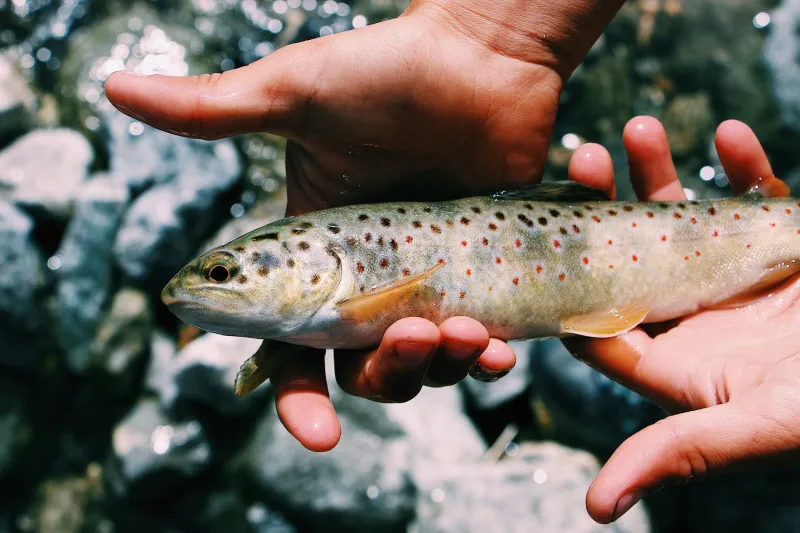
Cold-water specialists such as brook trout — a native species with particular ecological and cultural significance in the eastern United States — require water temperatures that remain below approximately 68°F during critical life stages. Above that threshold, feeding rates decline, immune suppression increases susceptibility to disease, and reproductive success drops sharply. At temperatures approaching 75°F, mortality rates rise steeply. These are not gradual, proportional responses. They are thresholds — points at which the system crosses from one state into another.
The concept of ecological tipping points is central to understanding what is happening in the refuge's waterways. Unlike linear systems, where change produces proportional responses, aquatic communities can remain apparently stable across a range of conditions before undergoing rapid, nonlinear reorganization once a critical threshold is crossed. The stability is real, but it is conditional — and the conditions are shifting.
What's Warming the Water
The thermal changes occurring in streams and ponds at EC Wildlife Refuge are the product of multiple interacting pressures. Regional climate trends are the broadest driver, with mean air temperatures and the frequency of extreme heat events both tracking upward across much of the eastern US over recent decades. But local factors amplify these regional signals in ways that matter enormously at the scale of individual stream reaches.
Riparian canopy loss is among the most significant local amplifiers. Mature trees overhanging a stream channel shade the water surface and moderate temperature during warm months. Where canopy has been reduced — by storm damage, disease, or development pressure beyond the refuge boundary — solar radiation reaches the water surface directly, driving temperatures substantially higher than in shaded reaches only a short distance away. Studies of comparable stream systems have documented temperature differentials of 5°F or more between shaded and unshaded reaches during summer months.
Impervious surfaces in the surrounding watershed also contribute. Stormwater running off parking lots, roads, and rooftops arrives in streams significantly warmer than groundwater, delivering thermal pulses that temporarily spike temperatures and stress aquatic communities. As development continues in areas adjacent to the refuge, this pressure is unlikely to diminish without deliberate mitigation.
The Invasion Opportunity
Every degree of warming that pushes native cold-water species toward their physiological limits simultaneously expands the viable habitat range for species adapted to warmer conditions — including several invasive competitors that pose significant management challenges at EC Wildlife Refuge.
Smallmouth bass, which perform well in water temperatures up to approximately 80°F, represent a particular concern in systems where brook trout historically dominated. As thermal conditions in higher-elevation stream reaches warm past the tolerance ceiling of native trout, smallmouth bass are capable of colonizing those reaches and establishing reproducing populations. The native species does not simply retreat to cooler water — in many systems, suitable thermal refugia are limited or absent, and local extirpation follows.
Similar dynamics play out at the microbial level. Warm water supports higher rates of cyanobacterial growth, and certain cyanobacterial species produce toxins that are harmful to wildlife and humans alike. The harmful algal blooms that have become more frequent in lakes and ponds across the eastern US are not random events — they are, in large part, thermally facilitated.
Reading the Warning Signs
The value of identifying tipping points in advance lies in the possibility of intervention before ecological reorganization becomes self-reinforcing. At EC Wildlife Refuge, several early warning indicators merit ongoing attention from both scientific staff and informed visitors.
The presence of temperature-sensitive macroinvertebrates — stonefly larvae, caddisfly larvae, and certain mayfly species — in stream samples is among the most reliable proxies for thermal health. These organisms require cold, well-oxygenated water and disappear from systems that have crossed critical thermal thresholds. Their absence from historically occupied stream reaches is a signal that warrants investigation.
Changes in fish community composition, particularly the upstream contraction of native trout distribution or the appearance of warm-water species in previously cold-water reaches, represent a more advanced warning. By the time fish community shifts are detectable, thermal stress is already well established.
Discoloration of pond surfaces during late summer — the greenish or blue-green tint associated with cyanobacterial proliferation — is visible to any attentive visitor and should be reported to refuge staff promptly.
The Management Imperative
Addressing thermal stress in aquatic systems requires action at multiple scales. At the local level, riparian restoration — the replanting of native shrubs and trees along stream banks — is among the most cost-effective interventions available. Canopy recovery can meaningfully reduce stream temperatures in affected reaches within a decade, providing thermal relief while simultaneously delivering bank stabilization, nutrient filtration, and habitat complexity.
At the watershed scale, collaboration with landowners and municipal partners beyond the refuge boundary is essential. Stormwater management, impervious surface reduction, and the preservation of remaining forested buffers in the surrounding landscape all reduce the thermal load delivered to the refuge's waterways.
The degree that changes everything is not inevitable. But preventing it from arriving requires recognizing, with clarity and urgency, that aquatic ecosystems do not warm gradually into a new equilibrium. They approach a threshold, and then they cross it.