Ghost Predators: How the Mere Scent of a Hunter Rewrites Animal Behavior Across EC Wildlife Refuge
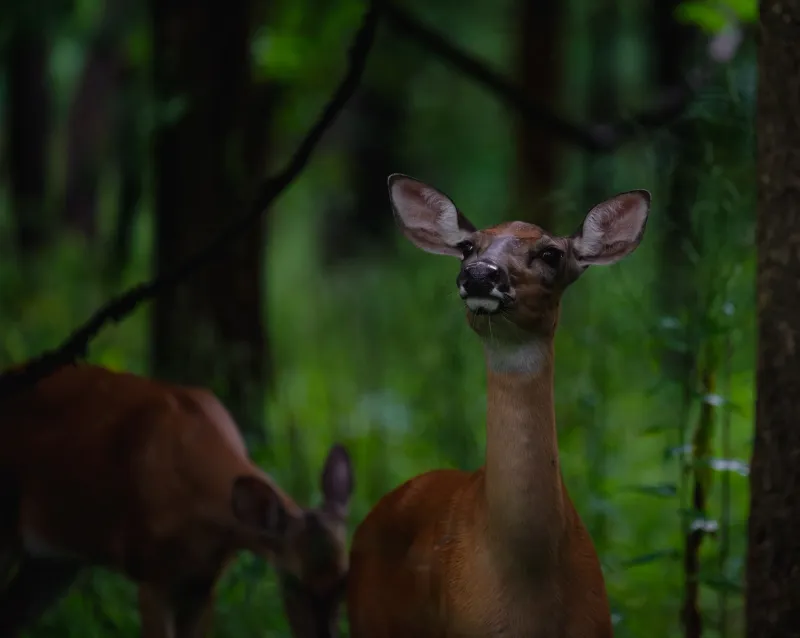
There is a moment, invisible to most visitors, that occurs dozens of times each day across the trails and meadows of EC Wildlife Refuge. A white-tailed deer lowers its head toward a stand of native grasses, nostrils working. Something registers — a molecular signature left hours earlier by a coyote that passed through without incident. The deer does not flee. But it does not stay, either. It moves on, leaving that patch of vegetation ungrazed.
That single, silent decision has consequences that ripple outward through the ecosystem in ways scientists are only beginning to fully map.
The Chemistry of Fear
Predator scent is not a simple alarm signal. It is a layered chemical message composed of compounds found in urine, feces, glandular secretions, and even the oils left on vegetation by a predator's fur. Prey animals have evolved extraordinarily sensitive olfactory systems capable of parsing these signals with remarkable precision — distinguishing, in some cases, between the scent of a well-fed predator and a hungry one, or between a predator that passed through recently and one that is currently in the area.
The behavioral response to these signals is known in ecological literature as the "landscape of fear," a concept developed over decades of field research and now considered one of the foundational frameworks for understanding how predators shape ecosystems. At EC Wildlife Refuge, this framework plays out across habitats ranging from upland hardwood forest to riparian corridors and open grassland.
When prey animals detect predator odor, they do not simply run. They recalibrate. Feeding rates drop. Animals spend more time scanning and less time with their heads down. They gravitate toward open terrain where visibility is higher, away from dense cover where ambush is possible. They alter their routes, their timing, and their choice of resting sites. Over time, these individual decisions accumulate into measurable patterns across the landscape.
Where Animals Don't Go Shapes What Grows
The vegetation effects of predator scent are among the most counterintuitive findings in modern ecology. At EC Wildlife Refuge, areas of dense shrub cover near known predator activity zones show markedly different plant composition than comparable areas with lower predator presence. Herbivore avoidance of these zones allows certain plant species to establish and persist that would otherwise be browsed back before reaching reproductive maturity.
This phenomenon — sometimes called a "trophic cascade triggered by fear" — means that predators are effectively gardening the landscape without ever consuming a single plant. The bobcats and coyotes that move through the refuge's trail corridors are, in a very real sense, functioning as ecosystem engineers through chemistry alone.
Researchers studying similar dynamics in other refuges and national parks have documented changes in stream bank vegetation driven by predator-induced shifts in where deer and elk choose to graze. When large herbivores avoid riparian zones out of fear, woody vegetation recovers along stream banks, roots stabilize soil, and water quality improves measurably. The refuge's own waterways may be subject to analogous processes, making predator presence — and the scent trails they leave behind — a meaningful variable in stream health monitoring.
Breeding, Nesting, and the Fear Tax
The influence of predator odor does not stop at feeding behavior. Reproduction itself is subject to chemical intimidation. Studies across multiple species have demonstrated that chronic exposure to predator scent — even in the complete absence of actual predation — suppresses reproductive output. Animals in high-scent zones produce fewer offspring, invest less in parental care, and wean young earlier, as if the body itself is responding to perceived risk by hedging against the future.
At EC Wildlife Refuge, this has practical implications for how habitat quality is assessed. A meadow that appears structurally suitable for nesting songbirds may be functionally compromised if it sits within a predator's regular scent-marking territory. Conversely, areas where predator activity has declined — due to habitat fragmentation, human disturbance, or other pressures — may see prey populations expand in ways that superficially appear healthy but actually signal a disruption of natural regulatory dynamics.
The nesting behavior of ground-foraging birds at the refuge offers a useful illustration. Species such as the Eastern towhee and several sparrow species select nest sites through a complex calculus that includes vegetation structure, proximity to food, and olfactory cues. Experimental research using predator urine in field settings has consistently demonstrated that birds alter nest placement and clutch investment in response to scent alone.
Human Presence as a Chemical Disruptor
One dimension of this story that warrants particular attention at EC Wildlife Refuge involves the olfactory footprint of human visitors. Human scent is perceived as a threat signal by many prey species — and, in some documented cases, even by mid-level predators. Heavy visitor traffic along certain trail corridors can effectively function as a chemical barrier, pushing wildlife away from otherwise suitable habitat and concentrating it in less-disturbed areas.
This does not argue against visitation. The refuge's mission explicitly includes connecting people with the natural world. But it does argue for thoughtful trail design and visitor management. Maintaining buffer zones between high-traffic areas and critical habitat features — nesting sites, water sources, foraging corridors — is one practical way to preserve the chemical integrity of the landscape that wildlife depends upon.
Reading the Refuge Through an Olfactory Lens
For visitors and citizen scientists engaging with EC Wildlife Refuge, the landscape of fear offers a new interpretive framework. The deer that abruptly changes direction on a forest trail is not behaving randomly. The songbird that abandons a seemingly perfect nesting site may be responding to information carried on the air that human senses cannot detect. The dense stand of native wildflowers thriving along a particular stream bank may owe its existence, in part, to the regular passage of a predator whose scent keeps herbivores moving.
Ecology, at its most fundamental level, is the study of relationships. The relationship between predator scent and prey behavior is one of the oldest and most consequential relationships in the natural world — a chemical conversation conducted across time and space, shaping the refuge's ecosystems in ways that no camera trap or species count can fully capture.
Understanding it is essential to protecting it.