What the Water Knows: Reading Stream Health to Forecast Wildlife Futures at EC Wildlife Refuge
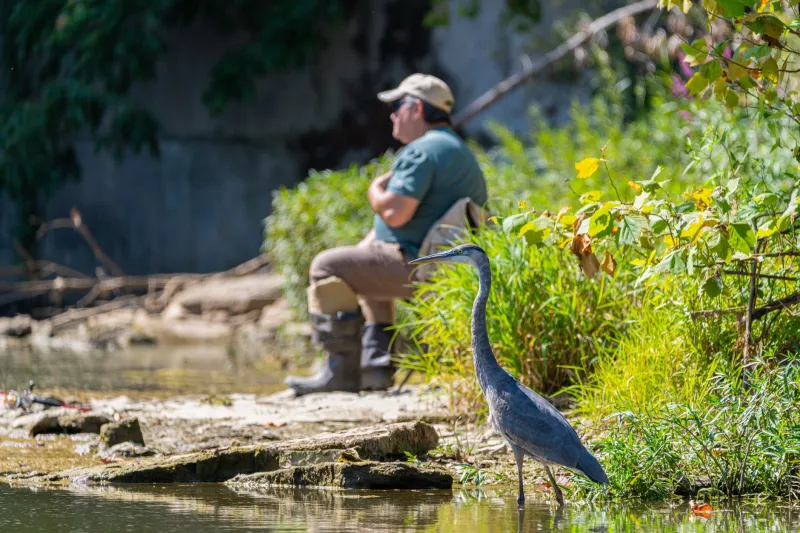
Streams carry more information than water. At EC Wildlife Refuge, hydrologists and aquatic ecologists are decoding the chemical signatures, biological communities, and flow dynamics of the refuge's waterways — and what they are finding tells a surprisingly precise story about which wildlife populations will flourish and which face an uncertain future.
The Stream as a Living Data Record
To the untrained eye, a healthy-looking stream offers few obvious clues about the state of the ecosystem surrounding it. The water runs clear, the banks are vegetated, and the surface is undisturbed. But aquatic scientists understand that appearances are often misleading. A stream is not merely a channel moving water from one place to another; it is a continuous recorder of everything happening in its watershed — the soils it drains, the vegetation it passes through, the land uses it reflects, and the biological communities it sustains.
At EC Wildlife Refuge, the aquatic monitoring program treats the refuge's streams and wetland channels as primary diagnostic tools. Rather than relying solely on direct wildlife surveys — which are time-consuming, weather-dependent, and inevitably incomplete — the refuge's science team uses water-based indicators to construct a detailed picture of ecosystem health across the entire watershed.
The results have fundamentally changed how refuge managers prioritize conservation interventions.
Macroinvertebrates: The Biological Scorecards of Stream Health
Among the most informative indicators available to aquatic ecologists are macroinvertebrates — the insects, crustaceans, worms, and mollusks visible to the naked eye that inhabit stream sediments, leaf litter, and submerged vegetation. These organisms are not merely interesting in their own right; they function as living scorecards of water quality and habitat condition.
Different macroinvertebrate species tolerate pollution and habitat disturbance to varying degrees. Stonefly larvae, for example, require cold, well-oxygenated, chemically stable water to survive. Their presence in a stream sample is a strong signal of high-quality conditions. Tubificid worms, by contrast, thrive in oxygen-depleted, organically enriched water and their dominance in a sample indicates significant degradation.
Refuge biologists collect macroinvertebrate samples from multiple points along the refuge's stream network on a rotating seasonal schedule. By calculating diversity indices — mathematical measures of how many species are present and how evenly populations are distributed — they can detect subtle changes in water quality long before those changes become visible or measurable through chemical testing alone.
Over the past three monitoring seasons, macroinvertebrate data from EC Wildlife Refuge streams has revealed a clear spatial gradient: reaches upstream of intact forested buffer zones consistently support higher diversity assemblages, while sections adjacent to agricultural land or impervious surface show reduced diversity and an increased proportion of pollution-tolerant taxa. This gradient has direct implications for species that depend on aquatic invertebrates as a primary food source — including several songbird species, numerous amphibian populations, and the refuge's resident brook trout.
Water Chemistry and the Cascade of Consequences
Macroinvertebrate communities tell scientists what has been happening in a stream over weeks and months. Water chemistry provides a more immediate snapshot — and the two data streams together create a remarkably comprehensive picture.
The refuge's monitoring program measures a suite of chemical parameters at each sampling station: dissolved oxygen, pH, specific conductance, nitrate and phosphate concentrations, turbidity, and temperature. Each parameter tells a distinct story, and the relationships between them reveal dynamics that no single measurement could capture alone.
Nitrate levels, for instance, reflect the degree to which agricultural nutrients are entering the watershed through subsurface drainage. Elevated nitrate concentrations promote the growth of filamentous algae, which initially increases food availability for certain invertebrate grazers but ultimately depletes dissolved oxygen as algal blooms decompose — a process that can eliminate sensitive species across large stream reaches in a matter of weeks.
Temperature data has proven particularly consequential. Stream temperatures at the refuge have increased measurably over the past decade, consistent with regional climate trends. Cold-water fish species are acutely sensitive to thermal changes; even modest warming can push water temperatures beyond the physiological tolerance thresholds of brook trout during summer low-flow periods. By combining temperature records with flow data, refuge hydrologists can now identify specific stream reaches that serve as thermal refugia — cool-water pockets where sensitive species concentrate during heat stress events — and prioritize those locations for enhanced riparian buffer protection.
Flow Regimes and the Architecture of Aquatic Habitat
Water chemistry and biological communities do not exist in isolation from the physical movement of water itself. Flow regime — the seasonal pattern of high and low discharge, the frequency and magnitude of flood pulses, and the duration of low-flow periods — is arguably the master variable structuring aquatic ecosystems.
At EC Wildlife Refuge, continuous-recording stream gauges capture water level data at fifteen-minute intervals throughout the year. This high-resolution record allows hydrologists to characterize the natural flow regime of each monitored reach and to detect deviations caused by upstream land use changes, water withdrawals, or altered precipitation patterns.
The practical significance of this data extends well beyond the stream channel itself. Many terrestrial wildlife species at the refuge depend on predictable flood pulses to trigger breeding behavior, activate floodplain food resources, and maintain the mosaic of wet and dry habitats that characterizes the refuge's interior wetlands. When flow regimes are altered — by upstream impoundments, agricultural tile drainage, or increased impervious surface in the contributing watershed — the downstream effects ripple through the entire food web in ways that are difficult to reverse.
Translating Data Into Action
The value of a monitoring program is ultimately measured by what it changes. At EC Wildlife Refuge, aquatic biomonitoring data has directly informed three major management decisions in the past two years: the prioritization of riparian buffer restoration along two degraded stream reaches, the design of a floodplain reconnection project intended to restore natural flow connectivity to a historically isolated wetland, and the identification of a previously unrecognized thermal refugium that has since been designated a sensitive area with restricted visitor access during summer months.
Perhaps most importantly, the data has given refuge managers a language for communicating watershed-scale conservation needs to landowners and local governments outside the refuge boundary. Stream health does not respect property lines. The macroinvertebrate communities and water chemistry signatures measured inside the refuge are shaped by land management decisions made miles upstream — and the monitoring data makes that connection concrete, quantifiable, and difficult to dismiss.
Water, it turns out, is an extraordinarily articulate narrator. The task of conservation science is simply to learn how to listen.