Uninvited Guests, Essential Roles: The Surprising Way Parasites Keep EC Wildlife Refuge's Ecosystem in Check
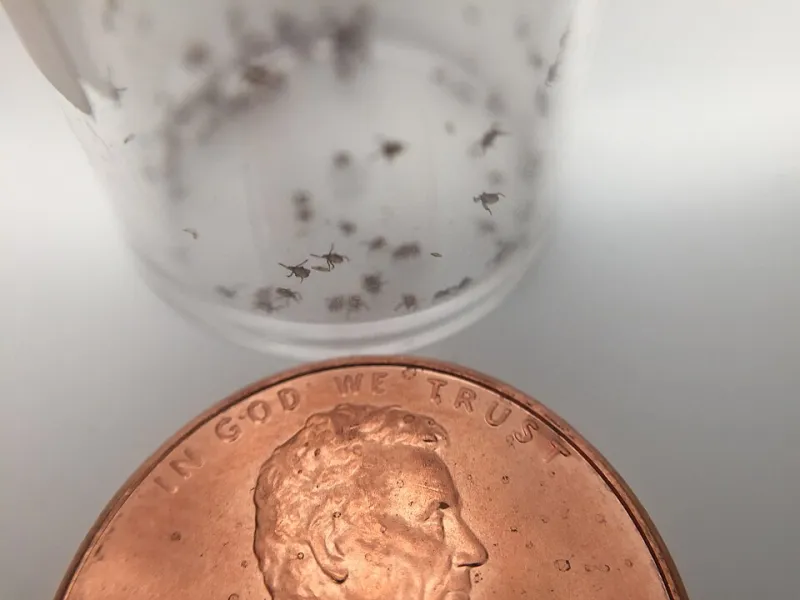
Photo: NIAID, CC BY 2.0, via Wikimedia Commons
Most visitors to EC Wildlife Refuge arrive hoping to catch a glimpse of a soaring raptor, a white-tailed deer stepping through morning mist, or a great blue heron standing motionless at the water's edge. Few arrive thinking about tapeworms. Yet the organisms that inspire the least admiration may be doing some of the most consequential work in the refuge's living systems.
Parasites—organisms that live at the expense of a host—are among the most abundant life forms on Earth. Ecologists estimate that parasitic species may actually outnumber free-living ones when all categories are considered, from microscopic protozoa and fungi to nematodes, flukes, ticks, and botflies. At EC Wildlife Refuge, these organisms are not merely incidental. They are functional components of a web far more intricate than any food pyramid diagram can convey.
More Than Just a Burden
The instinct is to frame parasites as pure antagonists—organisms that weaken, sicken, and ultimately destroy their hosts. That framing is understandable, but it is incomplete. In a regulated ecosystem, parasitic pressure rarely eliminates a host population outright. Instead, it modulates it.
Consider white-tailed deer, one of the refuge's most visible large mammals. Populations without adequate predator pressure have historically expanded to the point of overgrazing, stripping understory vegetation and destabilizing the plant communities that dozens of other species depend on. Parasites such as the Ostertagia roundworm and the liver fluke Fascioloides magna exert a quiet but meaningful drag on reproduction and survival rates within deer populations. Heavily parasitized individuals are less likely to successfully raise offspring, and animals weakened by chronic infection are more vulnerable to both predation and harsh winter conditions. The net effect is a natural ceiling on population growth—one that operates independently of, and in concert with, predator activity.
This is not coincidence. It is the outcome of millions of years of co-evolution between hosts and their parasites, a biological negotiation in which neither party benefits from the other's extinction.
Parasites as Predator Allies
The relationship between parasites and predators at EC Wildlife Refuge is more collaborative than it might initially appear. Predators are efficient hunters, but they are not indiscriminate ones. Research across North American ecosystems consistently shows that wolves, coyotes, bobcats, and raptors preferentially take prey animals that are already compromised—by injury, age, or infection.
Parasites make that selection process easier. A deer staggering from a heavy tick burden, or a rabbit whose coordination has been subtly impaired by Toxoplasma gondii infection, is more likely to become a predator's meal than a healthy, alert animal. This dynamic benefits predators by reducing the energetic cost of a successful hunt. It benefits the prey population as a whole by removing individuals that carry the highest pathogen loads before those loads can be transmitted more broadly. And it benefits the parasite indirectly, since many parasitic life cycles depend on passage through a predator host to complete.
The three-way relationship between parasite, prey, and predator is not a hierarchy. It is a triangle, and weakening any one side affects the structural integrity of the whole.
When the Balance Breaks
The refuge's scientific staff have observed what happens when this triangle is disrupted. Localized coyote removal in areas surrounding the refuge, often carried out by private landowners concerned about livestock, has repeatedly been followed by surges in small mammal populations. Rabbits and rodents, freed from consistent predator pressure, reproduce rapidly—and as their densities increase, so does the transmission rate of the parasites they carry. Diseases such as tularemia, which can cycle through dense rabbit populations with alarming speed, become more prevalent rather than less. The removal of predators, paradoxically, can intensify parasite-driven illness in prey species rather than relieving it.
This counterintuitive outcome underscores a principle that ecologists have long understood: the health of a wildlife population is not simply the absence of disease. It is the product of a dynamic equilibrium in which parasites, predators, prey, and habitat conditions are all actively engaged.
Chronic Wasting Disease: A Case Study in Complexity
No discussion of parasites and pathogens in a US wildlife refuge context would be complete without addressing chronic wasting disease, or CWD. Caused by misfolded proteins called prions, CWD affects cervids—deer, elk, and moose—and has been detected in dozens of states, with management implications for refuges throughout the country.
Unlike most parasites, prions do not follow the co-evolutionary logic that keeps host-parasite relationships in relative equilibrium. CWD is uniformly fatal, and its environmental persistence is extraordinary; prions can remain infectious in soil for years. At EC Wildlife Refuge, monitoring programs track deer health indicators and submit tissue samples from harvested and road-killed animals to state wildlife health laboratories. The data gathered informs both refuge management decisions and broader regional surveillance efforts.
What CWD illustrates—precisely because it departs from the pattern—is how unusual a truly destabilizing pathogen is. The vast majority of the parasitic relationships operating across the refuge function within bounds that have been shaped by evolutionary time. CWD is a reminder that those bounds are not guaranteed, and that the introduction of novel pathogens into naive host populations can produce outcomes with no historical precedent.
Rethinking What a Healthy Refuge Looks Like
For conservation practitioners and attentive visitors alike, parasites invite a recalibration of assumptions. A deer with ticks is not evidence of a refuge in poor condition. A coyote carrying intestinal parasites is not a cause for intervention. These are signs of a functioning ecological community, one in which the invisible threads of host-parasite interaction are woven into every visible relationship.
EC Wildlife Refuge's management philosophy reflects this understanding. The refuge does not pursue eradication of native parasites, nor does it treat every instance of wildlife disease as a crisis requiring human correction. The goal is to maintain the conditions under which natural regulatory processes can operate—which means protecting predator populations, preserving habitat complexity, and monitoring pathogen dynamics without reflexively intervening.
That restraint is itself a form of scientific literacy. It requires accepting that an ecosystem in balance will always contain organisms that cause suffering in individual animals, because those organisms are part of what prevents far greater suffering at the population level.
A More Complete Picture
The next time you walk the trails at EC Wildlife Refuge, consider what you cannot see. Beneath the surface of every interaction between predator and prey, every population boom and decline, every behavioral shift in the animals you observe, there is a layer of biological negotiation involving organisms too small to register on any visitor checklist. They are not the charismatic species that appear on refuge brochures. But they are, in their way, indispensable.
Ecological literacy means learning to hold this complexity without resolving it into something simpler. The refuge is not a stage set for the drama of visible wildlife. It is a system, and its health depends on every actor—including the ones that never take a bow.