Death, Renewal, and the Organisms Running the Whole Operation at EC Wildlife Refuge
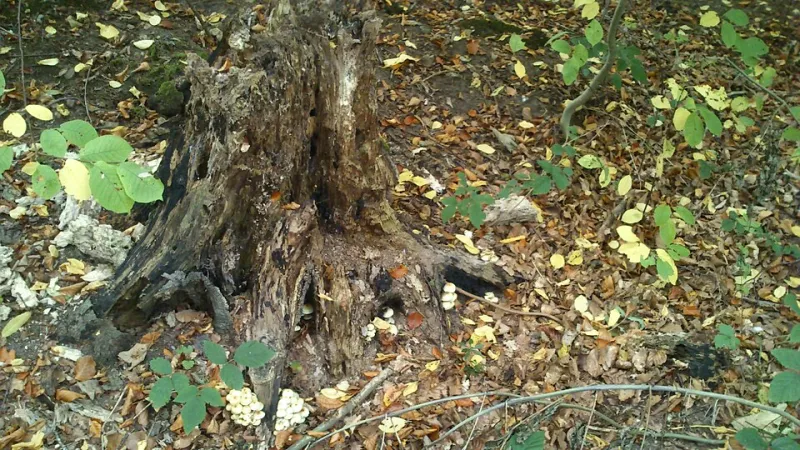
Photo: RhinoMind, CC BY-SA 3.0, via Wikimedia Commons
Walk any trail through EC Wildlife Refuge on a cool autumn morning, and you will almost certainly step over a fallen branch dusted with shelf fungus, sidestep a mat of decomposing leaves releasing a faintly earthy perfume, or notice a cluster of pill bugs retreating beneath rotting bark. Most visitors register these as background details—the scenery between the herons and the wildflowers. In reality, they are witnessing the refuge's most consequential biological process in action.
Decomposition is not the end of a story. It is the engine that writes the next one.
What Decomposers Actually Do
The organisms responsible for breaking down dead organic matter occupy a functional category biologists call decomposers or, more broadly, detritivores. This community includes an extraordinary range of life: bacteria too small to see with the naked eye, fungi whose visible fruiting bodies represent only a fraction of their true mass, and invertebrates such as millipedes, springtails, earthworms, and beetle larvae that physically shred organic material into smaller pieces.
Each group plays a distinct role in a carefully sequenced process. When a tree falls in the refuge's forested sections, wood-boring beetles and carpenter ants are often among the first to arrive, tunneling through the outer layers and creating entry points for moisture and microbial colonizers. Fungi follow, threading mycelial networks through the wood's cellular structure and secreting enzymes that dissolve lignin—one of the most chemically resistant compounds in nature. Bacteria, meanwhile, work at scales invisible to the eye, completing the final chemical transformations that release nitrogen, phosphorus, potassium, and carbon back into the soil and atmosphere.
This is not passive rot. It is an active, multi-stage biochemical disassembly that returns the raw materials of life to circulation.
The Carbon Connection
Perhaps the most consequential service decomposers provide is their role in the carbon cycle. Every living organism accumulates carbon as it grows. When that organism dies, the carbon stored in its tissues must go somewhere. Decomposers determine where.
In healthy, functioning soils like those found across much of EC Wildlife Refuge, microbial communities process dead organic matter in ways that sequester a significant portion of that carbon into stable soil compounds. This is not a trivial contribution. Healthy soils globally store more carbon than all the world's vegetation and atmosphere combined, and the microbial communities driving that storage are the reason why.
When decomposer communities are disrupted—by compaction, chemical contamination, invasive species, or prolonged drought—carbon that would otherwise be stabilized in soil is instead released as carbon dioxide. The refuge's ongoing efforts to protect native soil communities are therefore not merely about supporting obscure invertebrates. They are a meaningful component of broader climate resilience.
Nitrogen Without Decomposers: An Impossible Equation
Nitrogen deserves particular attention. It is the element most commonly limiting plant growth across North American ecosystems, and it cycles through the refuge's meadows, wetlands, and forests in ways that depend almost entirely on microbial action.
When a deer dies in the refuge, or when migratory waterfowl leave behind droppings along the wetland margins, or when last year's cattail stems collapse into the shallows, the nitrogen locked in those organic materials is not immediately available to plants. Specialized bacteria must first transform complex organic nitrogen compounds through a process called mineralization, converting them into forms—ammonium and then nitrate—that plant roots can absorb.
Without this microbial transformation, the nitrogen cycle stalls. Plants grow poorly. Insects that depend on those plants decline. The birds and mammals that rely on those insects follow. The entire food web compresses from the bottom. This is not a theoretical cascade; it is precisely what researchers observe in soils treated with broad-spectrum antimicrobials or in landscapes where soil disturbance has dramatically reduced microbial diversity.
A Closer Look at Fungal Decomposers in the Refuge
Of all the decomposer groups present at EC Wildlife Refuge, fungi merit special attention for the sheer scale of their influence. The visible mushrooms that emerge from forest floors and rotting logs each fall represent the reproductive structures of organisms whose true bodies—the mycelium—can extend for acres beneath the surface.
White-rot fungi, a functional group named for the pale, spongy appearance they leave behind in wood, are among the only organisms on Earth capable of fully breaking down lignin. Brown-rot fungi, by contrast, preferentially digest cellulose while leaving lignin largely intact, producing the crumbly, dark residue familiar to anyone who has handled very old wood. Together, these two groups process the bulk of coarse woody debris in the refuge's forested zones, transforming what might otherwise become impenetrable accumulations of resistant plant material into nutrient-rich soil over periods ranging from a few years to several decades.
The relationship between fungal decomposers and tree root systems is also worth noting. Many of the same fungal species that assist in breaking down dead wood also form mycorrhizal partnerships with living trees—a dual role that positions fungi as both recyclers and active supporters of forest productivity simultaneously.
Invertebrate Shredders: The Overlooked First Responders
Before bacteria and fungi can access much of the organic material in the refuge, invertebrates must do the physical work of fragmentation. Millipedes, isopods, earthworms, and the larvae of numerous beetle and fly species tear, chew, and tunnel through dead plant and animal matter, dramatically increasing the surface area available for microbial colonization.
Earthworms, in particular, have an outsized effect on soil structure. As they consume and process organic material, they excrete nutrient-rich castings that improve soil aggregation, water infiltration, and aeration. A single square meter of healthy soil in the refuge's upland sections may contain dozens of earthworms, each one continuously turning organic matter into a form that supports plant growth.
Springtails—minute, six-legged arthropods that are among the most abundant animals on Earth by population—graze on fungal hyphae and help regulate fungal community composition. Their feeding behavior indirectly shapes which decomposer species dominate at any given time, making them quiet but influential participants in nutrient cycling dynamics.
Why This Matters for Refuge Management
EC Wildlife Refuge's land management practices reflect a growing appreciation for decomposer communities. The deliberate retention of coarse woody debris—fallen trees and large branches that might once have been removed for aesthetic or safety reasons—provides the structural habitat that wood-decay fungi and saproxylic beetles require. Prescribed burns, when conducted, are timed and scaled in ways that preserve soil microbial communities in adjacent areas. Restoration plantings prioritize native species that have co-evolved with local fungal and bacterial communities over millennia.
Visitors exploring the refuge's interpretive trails will increasingly find signage acknowledging the ecological importance of what might appear to be simple decay. A nurse log hosting a cluster of oyster mushrooms is not a tree that failed. It is a tree that transformed—and in doing so, is feeding the next generation of the forest it once shaded.
An Invitation to Look Differently
Conservation often asks us to direct our attention upward—to the osprey banking over the water, the monarch drifting through the meadow, the wood duck disappearing into the cattails. These are the charismatic symbols of a healthy refuge, and they deserve every bit of the attention they receive.
But the next time you pause on a trail and notice a weathered log slowly returning to earth, consider what you are actually observing. Thousands of species, most of them invisible, are performing the chemical and biological labor that makes every living thing in this landscape possible. The air you breathe here carries oxygen released partly through the photosynthesis of plants nourished by decomposer-generated nutrients. The soil beneath your feet holds its structure because of organisms that have never been photographed by a wildlife camera.
At EC Wildlife Refuge, we believe that understanding this hidden layer of life is not a secondary concern—it is foundational to understanding why this place exists, and why protecting it matters.