Pathways Through the Patchwork: Why Wildlife Corridors Are the Lifelines of a Fragmented Landscape
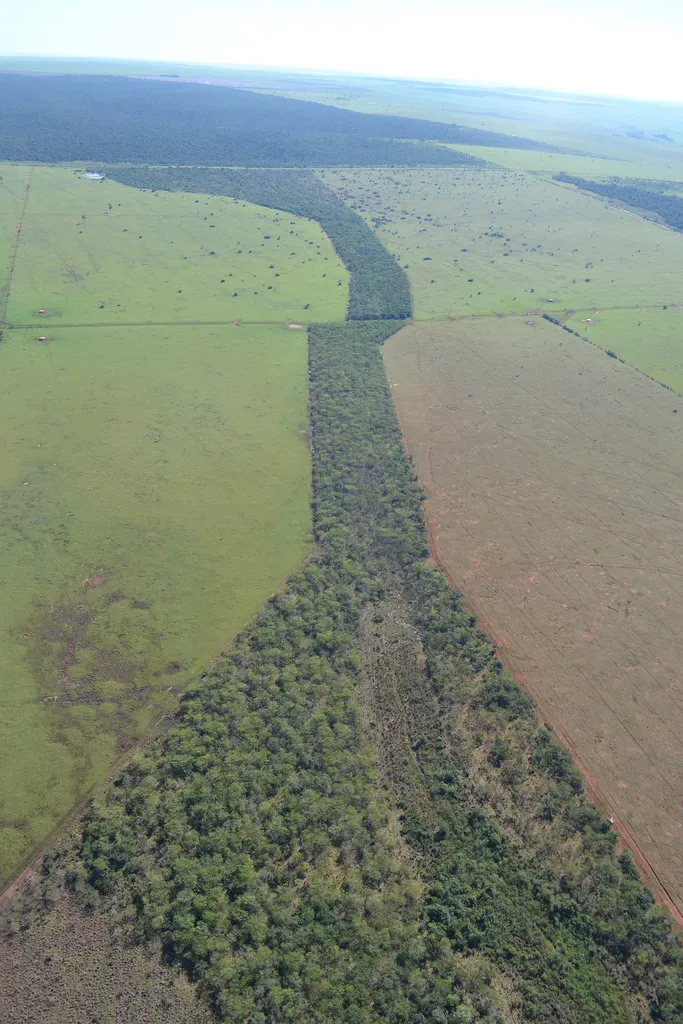
Photo: Ipe-institutodepesquisasecologicas, CC BY-SA 4.0, via Wikimedia Commons
For most people, a morning commute involves traffic lights, highways, and the occasional detour. For a white-tailed deer navigating the outskirts of a growing metropolitan region, the same journey involves fences, subdivisions, four-lane roads, and the constant threat of isolation from the resources it needs to survive. The landscape has been divided — not all at once, but incrementally, parcel by parcel — until what was once continuous forest or wetland now exists as a mosaic of disconnected fragments.
This fragmentation is one of the most consequential and least visible threats to biodiversity in the United States today. And it is precisely why wildlife corridors — the connective tissue of the natural world — have become a central focus of conservation work at EC Wildlife Refuge and across the broader region.
What a Wildlife Corridor Actually Is
A wildlife corridor is any strip, band, or network of habitat that allows animals to move between otherwise isolated patches of landscape. These pathways can take many forms: a riparian buffer of native trees lining a creek, a hedgerow crossing agricultural land, an underpass beneath a busy highway, or a chain of suburban backyards planted with native vegetation. What they share is function — they permit movement, and movement is the foundation of ecological health.
The science behind corridors is grounded in island biogeography, a field that emerged in the 1960s when ecologists began studying how the size and isolation of habitat patches affect the number of species they can support. Smaller, more isolated patches sustain fewer species over time. Corridors effectively enlarge those patches by enabling animals to travel between them, find mates, access seasonal food sources, and escape local disturbances such as drought or fire.
Without these connections, populations become genetically isolated. Over successive generations, inbreeding reduces resilience and adaptability. A disease outbreak, a single severe winter, or the loss of one critical food source can then eliminate a local population entirely — and with no corridor in place, that population cannot be replenished from neighboring areas.
The Regional Picture Around EC Wildlife Refuge
EC Wildlife Refuge sits within a landscape that reflects broader national trends: a mixture of protected public land, private agricultural holdings, and expanding residential and commercial development. The refuge itself provides a substantial core habitat — a place where species can breed, forage, and shelter with relative security. But core habitat alone is insufficient if the surrounding matrix is impenetrable.
Research conducted in partnership with regional universities has documented movement patterns of several indicator species across the refuge boundary and into adjacent lands. River otters have been tracked traveling along creek drainages that extend well beyond the refuge perimeter. Box turtles have been observed crossing managed grassland edges to access seasonal wetlands on private land. Neotropical songbirds stage along forested fence lines during spring and fall migration, using these narrow strips as stepping stones between larger woodland blocks.
These observations reinforce a fundamental principle: the ecological value of EC Wildlife Refuge is not contained within its boundaries. It radiates outward — and it depends, in turn, on what lies beyond those boundaries remaining navigable.
Where Corridors Succeed: Examples Worth Examining
Some of the most instructive corridor projects in the eastern United States have demonstrated that connectivity can be restored even in heavily modified landscapes, provided that stakeholders commit to coordinated action.
In the mid-Atlantic region, collaborative easement programs have preserved forested stream corridors connecting multiple public wildlife areas, enabling black bear and bobcat populations to maintain gene flow across hundreds of square miles. In the Southeast, longleaf pine restoration efforts have explicitly prioritized connectivity, linking isolated sandhill habitats and facilitating the recovery of the gopher tortoise — a keystone species whose burrows support dozens of other animals.
Closer to EC Wildlife Refuge, a multi-landowner initiative along a tributary of the regional watershed has established riparian buffers on privately held farmland, creating a near-continuous corridor that now supports nesting wood ducks, migrating waterfowl, and resident river otters across a stretch of land that, a decade ago, was largely unnavigable for aquatic and semi-aquatic species. The effort required patience, relationship-building with individual landowners, and modest financial incentives — but the ecological return has been disproportionately large relative to the investment.
The Role of Roads — and How to Address Them
No discussion of habitat connectivity is complete without confronting the role of roads. The American highway network represents one of the most formidable barriers to wildlife movement ever constructed. Roads kill an estimated one million vertebrates per day in the United States, and their effects extend far beyond direct mortality. Traffic noise alters bird communication and breeding behavior. Light pollution disrupts nocturnal species. The pavement itself creates a psychological barrier for many animals that will not cross open, exposed surfaces.
Mitigation infrastructure — wildlife underpasses, culverts designed for animal passage, and specially constructed overpasses — has demonstrated measurable success in restoring movement where roads bisect important habitat. Studies of highway underpasses in Florida, Montana, and the Pacific Northwest have documented use by everything from Florida panthers to grizzly bears to small mammals and reptiles. The critical variables are placement, dimensions, and the presence of guiding vegetation that directs animals toward crossing points.
Advocating for wildlife-friendly infrastructure at the local and state level represents one of the highest-leverage actions a community can take to support regional connectivity.
What Landowners and Communities Can Do
The most effective corridors are rarely the product of a single agency or organization acting alone. They are built incrementally, through the cumulative decisions of many landowners, municipalities, and community groups. This reality places meaningful power — and meaningful responsibility — in the hands of people who may not think of themselves as conservation practitioners.
For homeowners, the most impactful actions center on native plantings. A yard dominated by non-native turf grass offers little to a traveling pollinator, songbird, or small mammal. The same space planted with native shrubs, flowering perennials, and ground-layer vegetation becomes a functional node in a larger network. When neighbors adopt similar practices, individual yards aggregate into neighborhood-scale corridors that can support genuine movement.
Fencing practices matter as well. Standard agricultural and residential fencing often impedes the movement of deer, foxes, and ground-nesting birds. Where fencing is necessary, designs that allow passage — raised bottom rails, widely spaced lower strands on wire fencing — can significantly reduce their barrier effect.
Municipalities can contribute by preserving stream buffers in local ordinances, requiring wildlife-friendly culverts in road projects, and identifying undeveloped parcels that serve as stepping stones between larger habitat blocks. Regional land trusts and conservation organizations often have the technical capacity to help communities map these opportunities systematically.
A Connected Landscape Is a Resilient One
The fragmentation of American landscapes did not happen overnight, and restoring connectivity will not either. But the evidence is clear: ecosystems that are internally connected — where animals can move, genes can flow, and disturbances can be absorbed and recovered from — are fundamentally more resilient than those that are not.
EC Wildlife Refuge occupies a position of both ecological significance and community visibility. The work of connecting the refuge to the broader landscape, and connecting that landscape to the people who live within it, is among the most important work this institution undertakes. Corridors are not abstract conservation concepts. They are the routes along which life continues to move — and the degree to which that movement remains possible will shape the biological richness of this region for generations to come.