From Broken Wings to Open Skies: The Science and Soul of Wildlife Rehabilitation at EC Wildlife Refuge
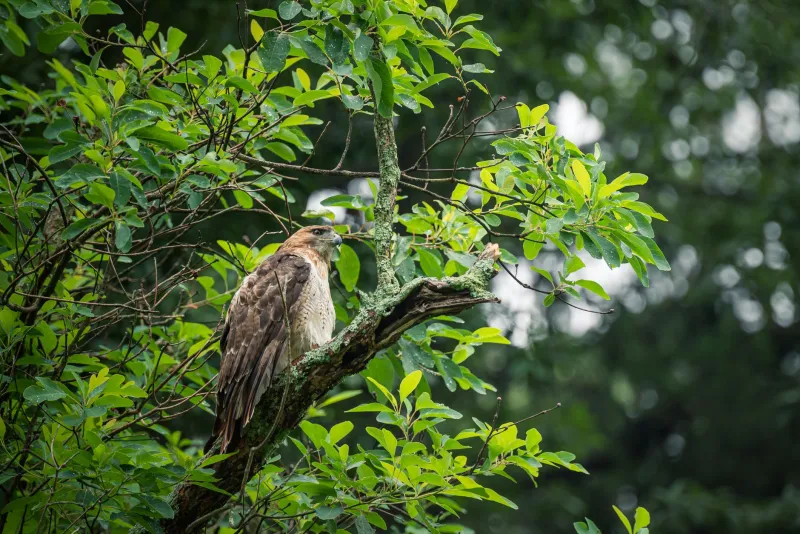
A red-tailed hawk arrives in a cardboard box, one wing hanging at an unnatural angle after a collision with a vehicle along the highway bordering EC Wildlife Refuge. A white-tailed deer fawn is found alone in a meadow, thin and disoriented, its mother nowhere to be seen. A river otter, entangled in discarded fishing line, is pulled from the water barely able to swim.
These are not unusual mornings at the refuge's wildlife rehabilitation program. What happens next — the weeks or months of careful, deliberate intervention that follow — is a discipline that blends veterinary medicine, behavioral science, and a profound respect for the boundary between human care and wild independence.
More Than Medicine: The Dual Challenge of Rehabilitation
Wildlife rehabilitation is frequently misunderstood by the public as a straightforward act of rescue and recovery. In reality, the medical component, while essential, represents only one half of the challenge. The deeper and arguably more demanding task is behavioral: ensuring that an animal does not lose the instincts it will need to survive the moment it is released.
"We are constantly managing a tension," explains the refuge's lead wildlife veterinarian. "On one hand, we need animals to tolerate enough human proximity to receive treatment. On the other hand, every moment of comfortable human contact is potentially a step toward habituation — and a habituated animal in the wild is a vulnerable one."
This tension shapes nearly every protocol in the program. Staff and volunteers wear camouflage coverings or use visual barriers when feeding certain species. Mammals, in particular, receive minimal direct handling once their acute medical needs are addressed. Vocalizations from human caregivers are strictly limited around species that might imprint on human voices. The goal, as one senior rehabilitator puts it, is to be "invisibly present" — close enough to monitor and intervene, but functionally absent from the animal's developing sense of its world.
The Imprinting Problem
Few concepts loom larger in wildlife rehabilitation than imprinting, the developmental process by which young animals form lasting social bonds with the individuals — or species — present during a critical early window. For birds of prey, this window is particularly narrow and consequential.
An owlet that spends its first weeks associating food delivery with human faces may grow into an adult owl that seeks human company, fails to fear predators, and cannot establish a natural territory. These animals, despite appearing physically healthy at release, face dramatically reduced survival odds.
To counter this, EC Wildlife Refuge uses conspecific fostering wherever possible — placing orphaned young animals with rehabilitated adults of the same species who can model appropriate behaviors. For raptors without suitable foster companions, staff employ hand puppets designed to mimic the appearance of adult birds, a technique now well-established in programs working with endangered species such as whooping cranes and California condors.
"People sometimes see the puppets and think it looks strange," admits one rehabilitator who has worked in the program for over a decade. "But the science is clear. What looks odd to us is completely natural communication from the perspective of the animal."
Measuring Readiness: The Criteria for Release
Determining when an animal is genuinely prepared for release is one of the most consequential judgments a rehabilitation team makes. A premature release can be as fatal as no release at all.
The refuge uses a multi-criteria assessment framework that evaluates physical condition, behavioral indicators, and ecological timing simultaneously. Physical benchmarks include weight restoration to species-appropriate ranges, full restoration of mobility or flight capacity, and the absence of infection or chronic pain. Behavioral benchmarks are more nuanced: rehabilitators observe whether animals demonstrate appropriate fear responses to simulated predator stimuli, whether they are foraging successfully in naturalistic enclosures, and whether social species are interacting normally with conspecifics.
Ecological timing adds another layer of complexity. Releasing a migratory songbird in mid-autumn, after its species' departure window has closed, may leave it without a cohort to travel with and without the resources of its wintering grounds. Releasing a hibernating species too late in the season may deny it the time needed to accumulate sufficient fat reserves. The program's staff maintain detailed phenological records — tracking seasonal cues like plant flowering, insect emergence, and temperature thresholds — to align releases with optimal ecological conditions.
Success Rates and Honest Accounting
The refuge is candid about the limitations of rehabilitation as a conservation tool. Survival rates following release vary considerably by species, injury type, and age at intake. Raptors that arrive as adults with orthopedic injuries face different odds than songbirds orphaned as nestlings. Mammals that have spent extended periods in captivity require longer and more intensive behavioral preparation than those admitted with acute, quickly resolved injuries.
Post-release monitoring, conducted through a combination of radio telemetry, leg bands, and — increasingly — lightweight GPS transmitters, provides data that continuously refines the program's protocols. Animals that do not survive their first weeks post-release are not considered failures in a moral sense, but their outcomes are carefully analyzed. Did the release site lack adequate food resources? Was the animal released into an established conspecific territory without sufficient habitat buffer? Each case contributes to a growing institutional knowledge base.
"We are honest with ourselves that rehabilitation is not a solution to the broader pressures wildlife face," says the veterinarian. "But it is meaningful work. Every animal we successfully return to the ecosystem is an individual life restored to its ecological role — and for species with small populations, that genuinely matters."
What Visitors and Community Members Can Do
EC Wildlife Refuge's rehabilitation program depends significantly on the broader community, both as a source of animals in need and as a network of informed, responsible stewards.
The single most important thing the public can do, staff emphasize, is resist the impulse to intervene immediately upon finding an animal that appears to be in distress. Many fawns, fledgling birds, and young rabbits found alone are not, in fact, abandoned — they are in a normal developmental phase during which their parents are nearby but not continuously present. Premature human intervention in these cases can create the very orphan situation it was meant to prevent.
When genuine intervention is warranted, the refuge asks that community members contact trained staff before attempting to handle or transport an animal. Improper handling can worsen injuries, introduce stress that compromises immune function, and — in the case of species capable of transmitting zoonotic diseases — pose health risks to the handler.
For those who wish to contribute more actively, the program offers structured volunteer opportunities in habitat maintenance, enclosure construction, and — for individuals with appropriate training — direct animal care assistance. The refuge also accepts donations of specific supplies, a current list of which is maintained on the refuge's website.
The Larger Meaning of the Work
There is something instructive in the philosophy underlying wildlife rehabilitation that extends beyond the animals themselves. The discipline demands that those who care most deeply about wildlife learn to express that care through restraint — through the disciplined suppression of the human instinct to comfort, to hold, to be recognized as a source of safety.
In this sense, the program embodies one of the refuge's foundational commitments: that genuine connection with nature is not about possession or familiarity, but about preserving the integrity of the wild on its own terms. When a rehabilitated hawk lifts from a gloved hand and vanishes into the canopy, the measure of success is not that it looks back.